2nd Century AD · UNESCO World Heritage
Roman Amphitheatre of Tarragona
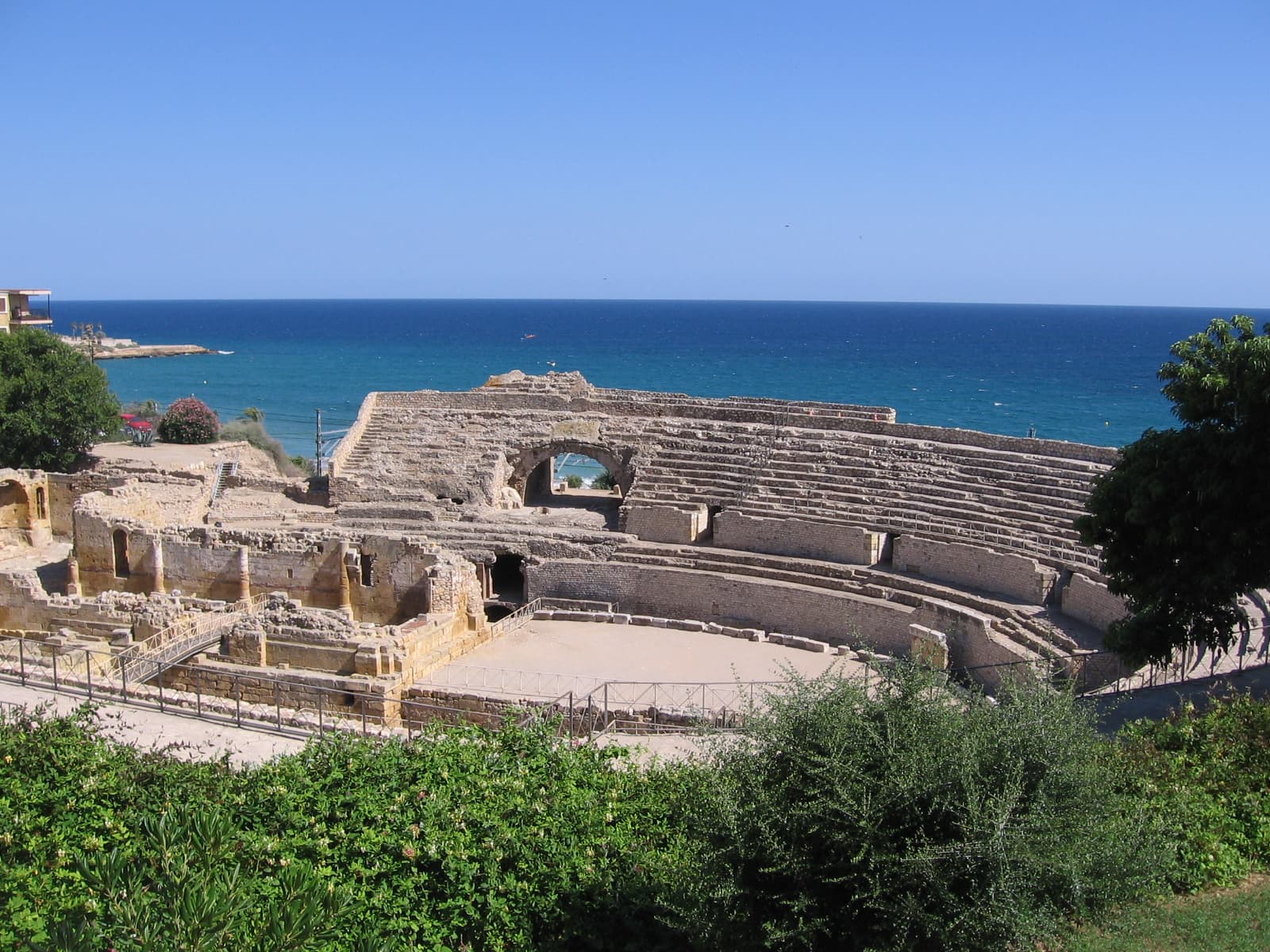
14,000 spectators, gladiatorial combat and views over the Mediterranean. The only Roman amphitheatre in the world built facing the open sea.
One thing sets Tarragona's amphitheatre apart from every other Roman monument in the world: you can swim a hundred metres from it. Built in the 2nd century AD on cliffs above the Mediterranean, this UNESCO World Heritage site is not only extraordinarily beautiful — it is woven into the living fabric of the city. Miracle Beach is literally at its feet. Watching the sunset from the terraces, the sea turning orange below, is one of the most memorable experiences Spain has to offer.
2,000 years facing the sea
14,000
capacity
2nd c.
built
218 m
length
2,000
years of history
The amphitheatre was built in the 2nd century AD at the height of Tarraco, capital of the province of Hispania Citerior and one of the most important cities in the western Roman Empire. With a capacity of 14,000 spectators and a length of 218 metres, it hosted gladiatorial combat, wild beast hunts and public spectacles. In 259 AD, bishop Fructuosus and his deacons Augurius and Eulogius were martyred in its arena, becoming the first Christian martyrs of Hispania. In the 6th century, the Visigoths built a basilica on the arena floor in their honour; its ruins are still visible today. The monument was declared a UNESCO World Heritage Site in 2000.
Tarragona
Patrimonio UNESCO
Practical information
Opening times
Tue–Sun 9:30–21:00 (summer) · 9:00–17:00 (winter) · Monday closed
Price
€4.50 single · €10 combined with Museu d'Història (MHT)
Address
Parc del Miracle, s/n, 43003 Tarragona
Getting there
10-min walk from Rambla Nova · Bus line 1, Miracle stop
What to see at the amphitheatre
The arena floor
The central space where the spectacles took place. You can walk down onto the same ground where gladiators fought 2,000 years ago — a visceral connection to the ancient world.
The underground cells
The passageways and holding cells beneath the arena where gladiators and animals awaited their turn. A direct immersion into the brutal mechanics of Roman spectacle.
The Visigothic basilica
Remains of the church built in the 6th century over the arena floor in honour of martyrs Fructuosus, Augurius and Eulogius. Layers of civilisation visible in a single space.
The Mediterranean view
From the upper terraces opens one of the most singular panoramas in the Roman world: the infinite blue sea, the beaches at the monument's feet and, on clear days, the Balearic Islands on the horizon.
Visit tips
- →
The best light for photographing the amphitheatre is early morning (before 10 am) or in the golden hour before sunset: the coral-coloured stone glows in an extraordinary way.
- →
Avoid visiting between 12 and 3 pm in July and August — the sun hits the terraces directly and there is no shade. Bring water and sunscreen regardless of the season.
- →
The most spectacular photo angle is from the Balcó del Mediterrani viewpoint, a 5-minute walk uphill: from there you get the full amphitheatre with the sea behind it.
- →
Buy the €10 combined ticket with the Museu d'Història de Tarragona: it includes the Roman Circus, the Forum and other archaeological highlights.
- →
After the visit, head down to Miracle Beach. Swimming in front of a 2,000-year-old Roman amphitheatre is an experience with no equal anywhere in the world.